
Before Fish out of Water had a name, there was simply a question.
What happens when spatial design, theatre, immersive environments and museology come together? This was where that exploration began.
What happens when a memory becomes a place?
Memory is often thought of as something we retrieve. A smell, a taste or a familiar sound can instantly transport us somewhere else. This project explored the opposite possibility. Could an environment help someone experience a memory they had never lived themselves?
The challenge
The challenge was to create an environment that encouraged discovery without giving away the answer. Visual clues were deliberately reduced to avoid preconceived associations, allowing sound, taste, smell, touch and interaction to guide participants instead.
The turning point
Early conversations explored cognitive dissonance through food—creating something that looked like one flavour but tasted of another. While interesting, it felt like that experiment had already been explored.
The project gradually shifted towards a different question:
What if the environment itself became the memory?
The experience
6 strangers arrived at a specific time.
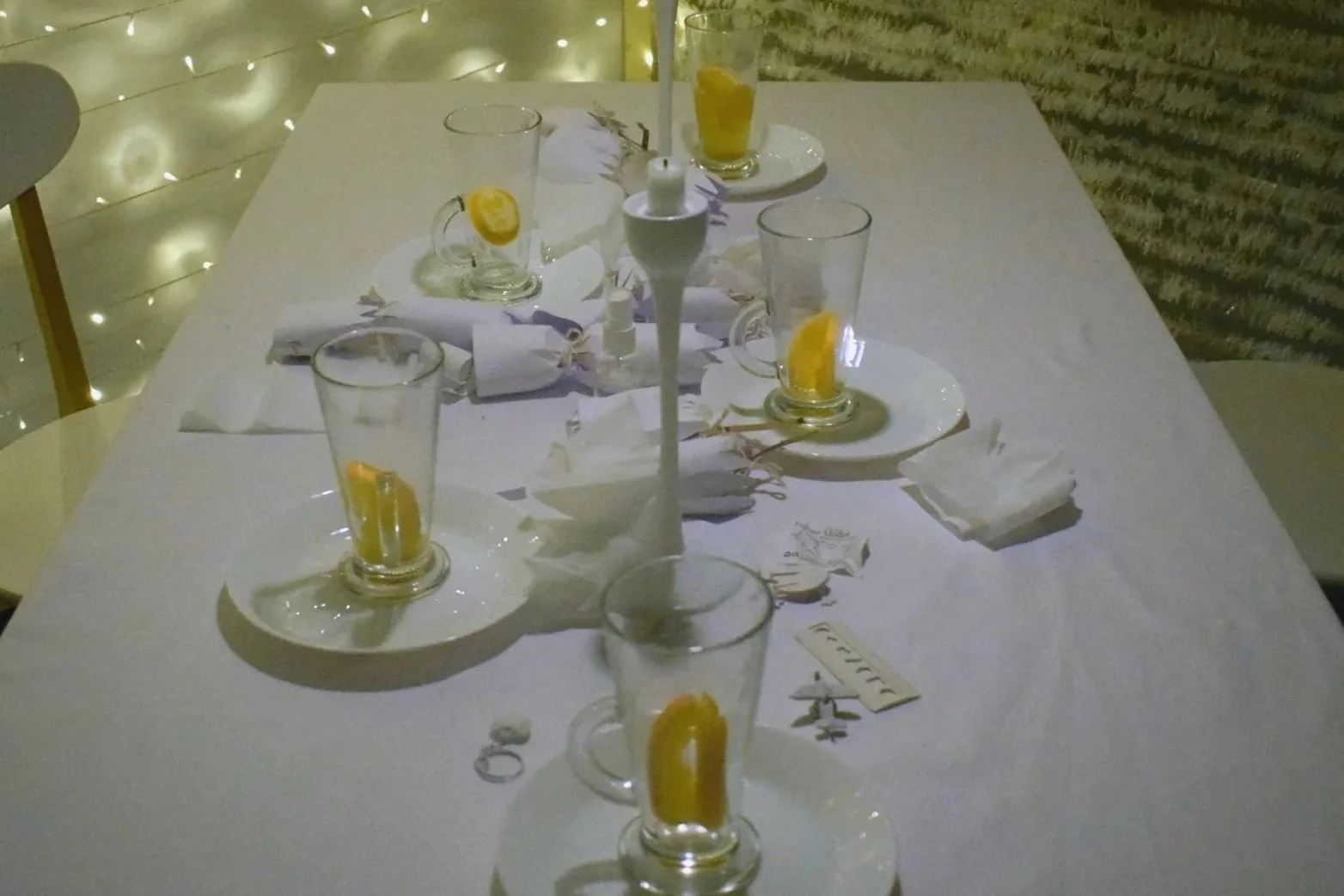
They were guided through a sequence of four environments via a soundscape. Each represented a food memory. Rather than being told what the memories were, they explored, tasted, smelled, listened and talked.
The hope wasn't that they'd guess correctly. It was that they'd notice, speculate and make connections with one another.
The conversation became part of the artwork.
What remained
The lasting discovery wasn't whether participants experienced a particular memory, but what happened when they started sharing their own.
The environments became catalysts for conversation rather than destinations with a single answer. Over the last ten years, that idea has continued to evolve into what is now Fish out of Water's philosophy of Generous Design.
What began as a question about memory became a way of designing experiences. Today, every Fish out of Water experience is designed to become a catalyst rather than a conclusion.
Project originally developed as part of an MA in Art & Design (2016).